How to Choose the Right Pressure Washer Nozzle
How to Choose the Right Pressure Washer Nozzle
Grab the wrong nozzle and a pressure washer will either do nothing useful or too much. Too gentle, and you’re standing there for an hour watching grime laugh at you. Too aggressive, and you’ve just stripped the paint off the deck, gouged a groove into the fence, or turned your mortar joints into gravel.
The good news: pressure washer nozzles are colour-coded so you don’t have to guess your way into wrecking something. Once you know what each one does, picking the right one takes about two seconds. Here’s the two minutes of reading that’ll save your weekend project.
At a glance:
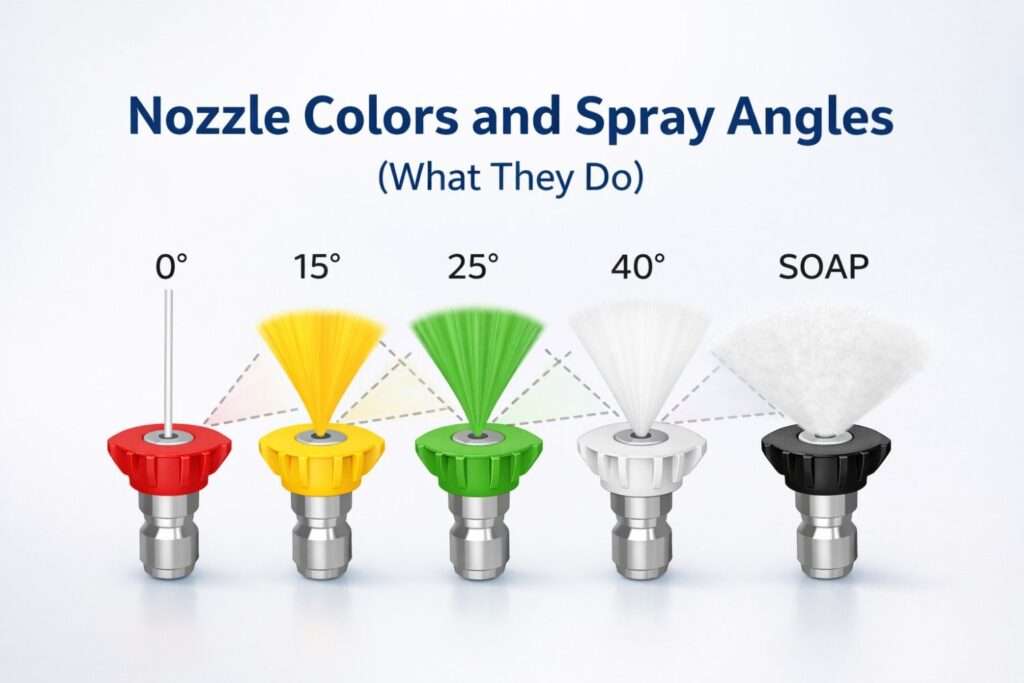
| Nozzle colour | Spray angle | Best for |
|---|---|---|
| Red | 0° | Unpainted metal or concrete only — never wood |
| Yellow | 15° | Grills, driveways, concrete/brick paths, unpainted brick or stucco |
| Green | 25° | Everyday all-rounder: yard tools, sidewalks, unpainted siding, gutters, concrete, brick |
| White | 40° | Cars, RVs, boats, wood, painted brick/stucco, vinyl, painted siding |
| Black | Low pressure | Applying cleaning solution — safe on any surface, but check the solution itself first |
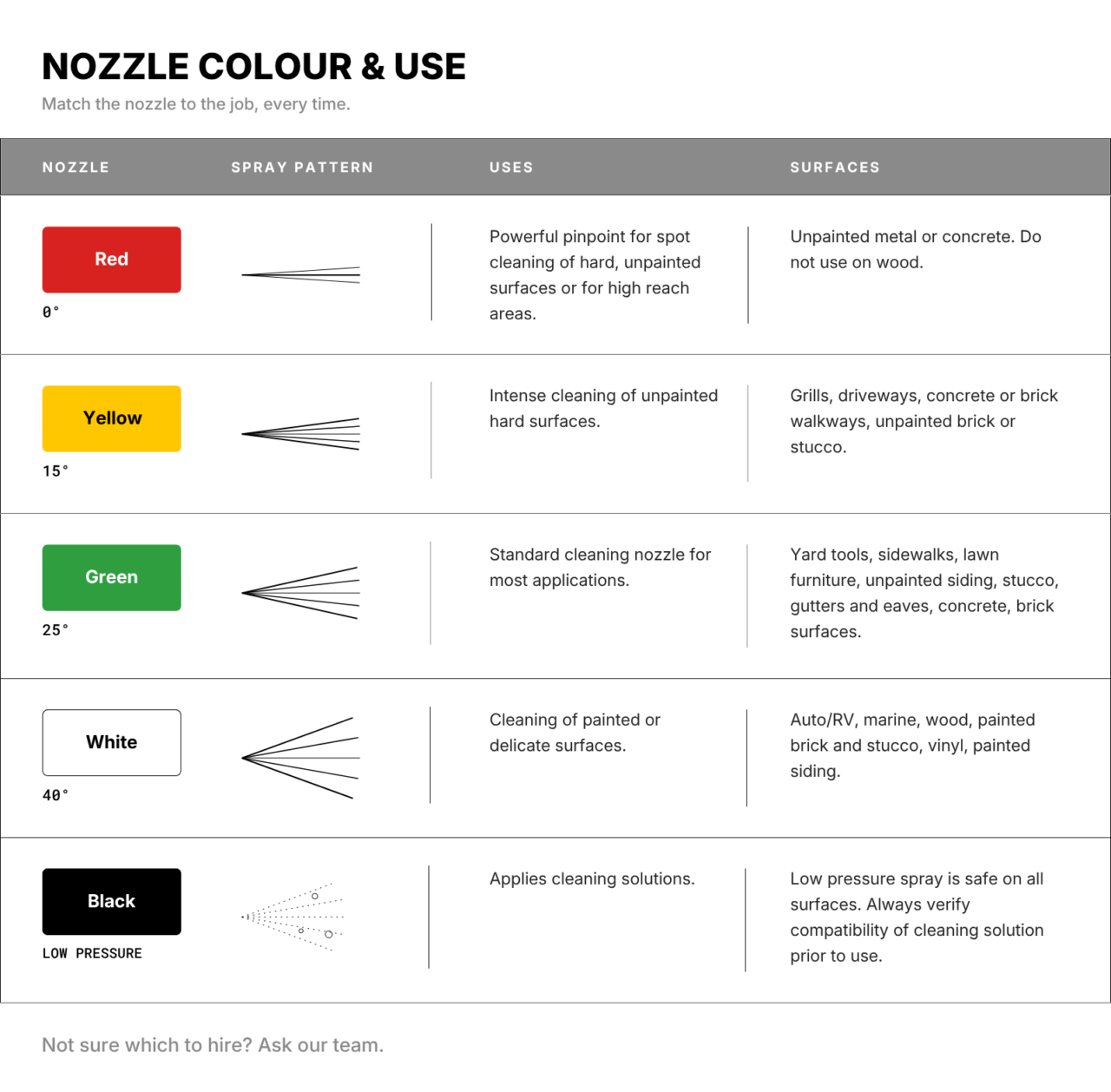
Red, yellow, green, white, black: what each nozzle actually does
Most pressure washers come with some or all of these five nozzles, each set to a different spray angle. The narrower the angle, the more concentrated and more aggressive the spray.
Red (0°) — pinpoint jet, maximum force
The red nozzle sprays a dead-straight, zero-degree jet with no spread at all. It’s the most powerful nozzle in the set, and also the one with the least room for error.
Use it on: unpainted metal or concrete only. Think stubborn stains on a bare concrete pad, rust on metal machinery, or a hard-to-reach spot up high that needs the extra distance a tight jet gives you.
Never use it on: wood, painted surfaces, or anything you’re not prepared to damage. At this pressure, “cleaning” and “cutting” are closer together than you’d think.
Yellow (15°) — narrow, intense fan
A step down from red, but still a serious amount of force in a tight fan pattern.
Use it on: grills, driveways, concrete or brick paths, and unpainted brick or stucco.
Go carefully on: anything soft or painted — the yellow nozzle can still mark surfaces that can’t take a full-strength blast.
Green (25°) — the everyday all-rounder
If you only remember one nozzle, make it this one. Green is the standard, do-most-jobs setting — wide enough to be forgiving, strong enough to actually clean.
Use it on: yard tools, sidewalks, lawn furniture, unpainted siding, stucco, gutters and eaves, concrete, and brick. This is where most general clean-ups on the property should start.
White (40°) — wide, gentle fan
A much wider spread for a much gentler clean — built for surfaces that need a wash, not a blast.
Use it on: cars, RVs, and boats, wood, painted brick or stucco, vinyl, and painted siding. If it’s painted, sealed, or otherwise a bit precious, this is your nozzle.
Black — the soap nozzle
The odd one out — this one’s about pressure, not angle. The black nozzle drops the pressure right down and is designed purely for applying cleaning solution, not for rinsing or blasting anything off.
Use it on: pretty much any surface, since it’s low pressure by design — but check the cleaning solution itself is right for that surface before you start. The nozzle being safe doesn’t mean every chemical is.
The rule of thumb
When in doubt: start wide, step down only if you need more force.
Begin with white or green, see how the surface responds, and only move to yellow or red if you genuinely need the extra grunt. And whatever nozzle you’re using, test an inconspicuous patch first — a corner of the deck, a hidden spot on the siding — before you commit to the whole surface. Thirty seconds of testing beats an afternoon of touch-up work.
Common mistakes we see
- Reaching straight for red because “more pressure = cleaner.” More pressure just means more damage, faster, if the surface can’t handle it. Match the nozzle to the job, not the other way around.
- Using red or yellow on wood or painted surfaces. This is the classic one — stripped paint, gouged timber, and fence palings that suddenly look ten years older. Wood and paint want white, full stop.
- Skipping the test patch. Every surface is a little different — age, sealant, how weathered it is. A quick test in a corner tells you more than any chart can.
- Standing too close. Pairing the wrong nozzle with the wrong distance makes the damage worse. As a general rule, start further back than feels necessary and move in gradually.
Got the wrong nozzle, or no pressure washer at all?
If your current nozzle kit’s gone walkabout or you’re not sure your machine even came with the full set — we stock genuine Kärcher nozzles and accessories in-store and online, including full nozzle kits so you’ve got every colour covered.
Don’t own a pressure washer yet, or don’t want to for a once-a-year job? Hire one from us or buy a pressure washer and we’ll talk you through everything you need to know before you leave the counter — no guesswork required. Either way, if you’re standing in the shop trying to decide between yellow and green, just ask. That’s what we’re here for.
FAQ’s
Yellow for tough, ground-in dirt on bare concrete or brick, or green if it’s a lighter clean or the surface is a bit worn. Start with green and step up to yellow only if you need to.
It’s the soap nozzle — it drops the pressure right down so it can apply cleaning solution rather than blast anything off. It’s safe on virtually any surface, but the cleaning solution itself still needs to be right for that surface.
No — pressure washers need a nozzle attached to control the spray. Running one without a nozzle, or with a damaged one, sends water out unpredictably and puts a lot of strain on the machine. If your nozzle’s missing or cracked, replace it before your next use.
Best case, nothing much — it’s just less effective than it could be. Worst case, you strip paint, gouge wood or soft masonry, or damage whatever you’re cleaning. When you’re not sure, start with a wider nozzle (white or green) and a test patch, and work up from there.